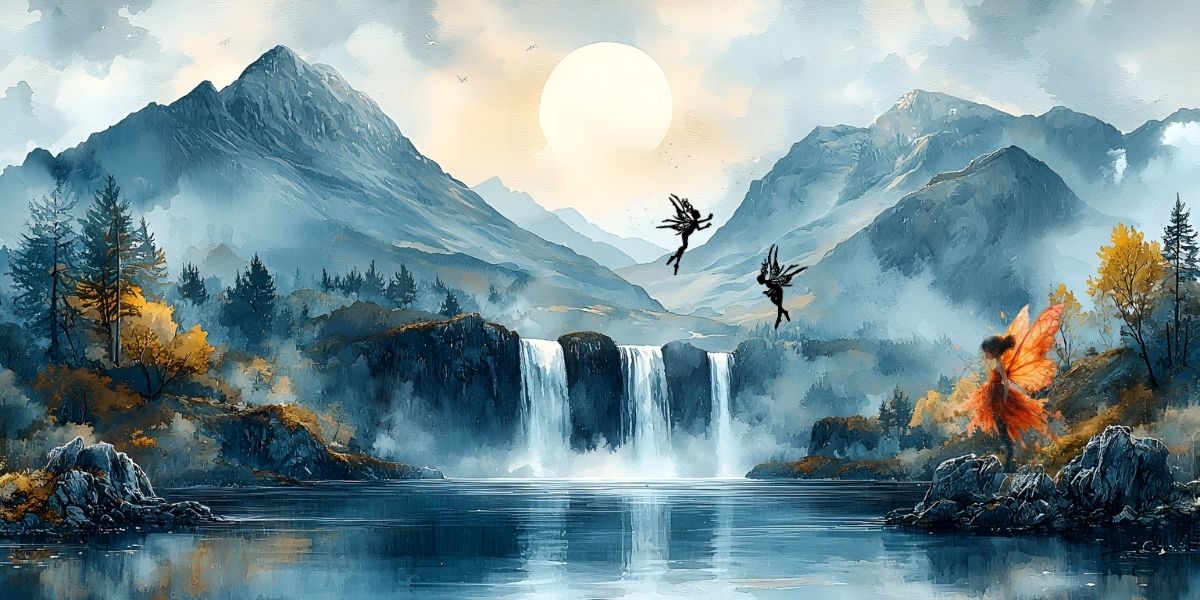
“Fantasy, myth, legend, truth, all are intertwined in the story that is Scotland.”
— Laurence Overmire
Scotland is a land shaped as much by story as by stone. Its glens, hills, islands, and waterways are steeped in folklore, home to selkies and kelpies, witches and saints, spirits of place, and, of course, the Fair Folk.
To walk through Scotland with an open heart is to realise that these stories were never meant to stay in books. They belong to the land itself. In place-names, in half-remembered customs, and in landscapes that feel just a little too alive to be entirely ordinary.
This is not a complete overview, as that would be near impossible. Any place bearing names like Sìth, Sìdh, or Shee hints at older layers of meaning, and Scotland is rich with them. What follows is a small gathering of places where the presence of the Good Folk has long been felt, locations where myth, legends and landscape still quietly meet.
Glenshee: The Glen of the Fair Folk
Glenshee takes its name from the Gaelic Gleann Sìth, the Glen of the Fairies. Those who once lived here were known as the Sithichean a’ Ghlinnshith, the Elves of Glenshee, and the glen has long been associated with both faerie lore and heroic legend.
This is a place where myths layer upon myths. The tragic tale of Diarmuid and Gráinne is said to end here, with Diarmuid slain by a boar and buried in the glen beside his beloved. Nearby stands Dùn Shìth, the Hill of the Fairies, an ancient meeting place marked by a standing stone dating back to the Bronze Age. Even now, the glen carries a sense of gathering, olden tales that still linger long after the folk that once lived here have long passed.

Rosemarkie Fairy Glen: A Place of Offerings and Flow
Tucked away on the Black Isle, Rosemarkie Fairy Glen feels like a place slightly out of time. Waterfalls tumble into deep pools, woodland paths wind beneath moss-covered trees, and the air carries a sense of gentle enchantment.
The glen has long been regarded as a fairy place, once honoured through well-dressing rituals offered in gratitude to the spirits believed to care for the land. Even today, clootie trees and wishing offerings can still be found along the paths. Some describe the area as a high-energy point in the landscape, whether the land drew the Fair Folk here, or whether their presence shaped the energy, is left to quiet speculation.

Slains Castle – The Darker Faces of Faerie
Not all faerie lore comes in through the gentle lens of Victorian era fancies. Scotland’s folklore also carries warnings, and Slains Castle, perched dramatically on the Aberdeenshire coast, is associated with the Baobhan-Sìth, dangerous faerie women said to lure travellers with beauty, song, and dance.
These tales remind us that the Otherworld was never sentimentalised in older traditions. Slains is also famously linked to Bram Stoker’s Dracula, and it’s tempting to imagine how local stories of blood-drinking fae and haunted landscapes fed his imagination. This is a place where myth leans into the uncanny, best approached with respect and awareness.

The Eildon Hills and Rhymer’s Glen: The Path to Elfland
Near Melrose rise the triple peaks of the Eildon Hills, long associated with the story of Thomas the Rhymer. According to legend, Thomas encountered the Queen of Elfland beneath the Eildon Tree and was taken into the Otherworld for seven years.
When he returned, he was gifted with prophecy and the inability to lie, becoming “True Thomas.” Some traditions say he later returned to Elfland and still resides beneath the hills. Even today, the Eildon Hills feel charged with story, a place where the boundary between worlds feels thin.
Tomnahurich: The Fairy Knowe of Inverness
Rising quietly on the edge of Inverness, Tomnahurich, the Hill of the Yews, has long been regarded as a fairy knowe. Though now a cemetery, it was once believed to be an entrance to the Otherworld.
One well-known tale tells of two fiddlers lured inside the hill to play at a fairy feast. When they emerged the following morning, they discovered centuries had passed. Today, the walk to the summit offers wide, impressive views over the city and river, a meeting place of old belief and modern life.

Schiehallion: The Fairy Hill of the Caledonians
Schiehallion’s name is often translated as the Fairy Hill of the Caledonians. Legend tells of great faerie gatherings held here, hosted by Queen Mab herself, bringing together tribes from across the region.
The mountain is riddled with caves and hidden passages, and it’s said that if no revels are seen on the surface, they are simply taking place beneath the hill. Schiehallion remains a place of quiet power, one that asks for reverence rather than explanation.

The Fairy Pools, Isle of Skye: Water Between Worlds
Hidden among the Cuillin Hills, the Fairy Pools have long been associated with the Good Folk. Before modern popularity, these clear pools and waterfalls were considered a place of summer gathering for faerie beings.
Visit early or late in the day, and the landscape still reveals its softer magic, water moving over stone, light shifting, the sense that something watches kindly, but from a distance.
Dunvegan Castle, and its Fairy Flag
At Dunvegan Castle, seat of Clan MacLeod, one of Scotland’s most famous faerie relics is kept, the Fairy Flag. Said to have been gifted by a fairy bride to a MacLeod chief, the flag holds protective powers that may only be called upon three times.
It has already been used twice. Whether relic or legend, the story binds clan, land, and Otherworld together in a living tradition.

Doon Hill, Aberfoyle: A Portal to Faerie for the Reverend Robert Kirk
Doon Hill, near Aberfoyle, is inseparable from the story of Reverend Robert Kirk, author of The Secret Commonwealth of Fauns, Faeries and Elves, one of the most important texts on faerie belief in Scotland.
Kirk vanished one night while walking on the hill in 1692. Some say he suffered a sudden illness. Others believe he was taken by the Fair Folk for revealing too much of their world. His grave can still be visited in the old kirkyard, while Doon Hill remains a place many approach quietly, aware that it has long been considered a threshold between worlds.
Walking with Respect in Otherworldly Places
If you find yourself visiting these landscapes, tradition suggests a few gentle courtesies. The Fair Folk are rarely fond of iron, salt, or rowan, and they are best addressed as the Good Folk rather than “fairies.” More importantly, leave places as you find them. Stone stacks, offerings, and disturbances are often discouraged; respect, not proof, is the heart of folklore.
Scotland is rich with enchanted places far beyond this small gathering. Wherever you wander in Alba, if you walk slowly, listen closely, and honour the land, you may find that the stories begin to find you.
Step Into the Story
App/ websites:
Megaliths Pocket Guide in the Apple store
Books:
Magical Britain, 650 Enchanted Mystical Sites
The Lore of Scotland: A Guide to Scottish Legends (organised by location)
Photos are my own, as well as a few from VisitScotland
Comments
One response to “Where the Fair Folk Still Walk: Scotland’s Enchanted Faerie Landscapes”
This is a wonderful guide.