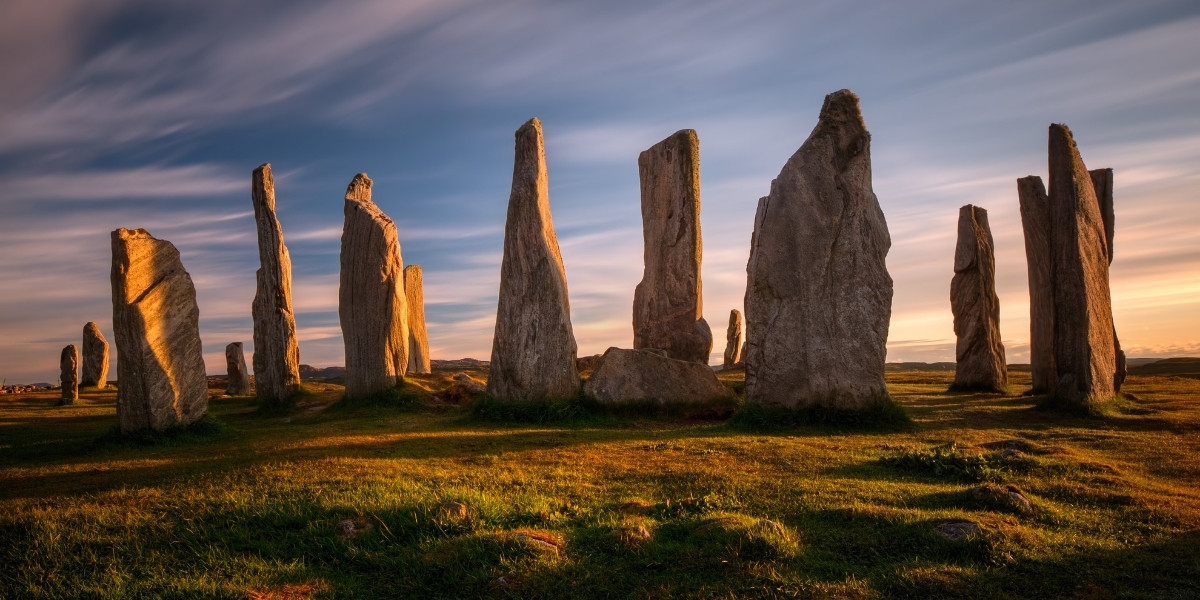
In uncertain times, many people feel drawn to the edges of the world: places where land, water, forest and sky meet.
Across cultures and centuries, certain landscapes have always held a special meaning. Hilltops, burial mounds, river crossings, forest edges and standing stones were often treated as more than ordinary ground. They were understood as threshold places, spaces that sit between worlds.
Today we might call them liminal landscapes. And in unsettled times, people often feel their pull again.
What Is a Liminal Place?
The word liminal comes from the Latin limen, meaning threshold. A threshold is not a destination. It is a place of transition: the doorway between rooms, the shoreline between land and sea, the moment just before dawn when night begins to lift. In landscape, these threshold places appear where natural boundaries meet.
- Riverbanks
- Crossroads
- Hilltops
- Forest edges
- Burial mounds
- Stone circles
- Sacred wells
Our ancestors recognised these locations instinctively. They understood that places of transition often carry a different quality of atmosphere. Something quieter, deeper, more reflective. These were the places where stories were told about the Otherworld, where offerings were left, where people paused between one phase of life and another.

Doon Hill, Aberfoyle
Why Humans Have Always Marked These Places
When archaeologists and historians study ancient landscapes, a pattern emerges. Sacred sites rarely appear in random locations.
Burial mounds are often placed on ridges or hilltops. Stone circles appear where the horizon opens wide and on top of leylines. Wells are protected where fresh water rises from the ground. Crossroads become meeting points between communities.
These places were understood as points of passage. In mythic language, they were often described as places where the boundary between worlds grew thin. Not necessarily in a literal sense, but in the way they invited reflection, awareness and transformation.
Carl Jung spoke about the importance of symbolic landscapes in human psychology. Certain environments naturally evoke the inner processes of transition: leaving one stage of life, entering another, or confronting uncertainty. We all, in our own lives, experience thresholds that are to be crossed, from the moment we come into the world until the moment we leave it. In this sense, the landscape becomes a mirror for the psyche.
Why We Are Drawn to Them Today
It is not surprising that in times of upheaval, which in itself can be seen as a threshold, away from the old way of being, people begin seeking these places again.
Modern life rarely allows space for thresholds. We move quickly from task to task, rarely pausing between one state of being and another. Yet something changes when we step into a quiet forest clearing, stand beside the sea, or climb a hill overlooking a town. The body slows. The mind settles.
These places remind us that humanity has lived through uncertainty many times before. Generations before us stood on similar ground, facing their own unknown futures. The landscape carries that memory quietly. And sometimes simply standing within it can bring perspective.

Kilmartin Glen
Finding Liminal Places Near You
You do not need to travel far to find a threshold landscape.
Often they exist in unexpected or expected places close to home. Look for places where elements meet or where the atmosphere feels subtly different.
- A bridge crossing a river
- The edge of woodland
- A hill with wide views
- An old stone circle
- A quiet beach at dusk
- A sacred well or spring
- A park or garden that feels unexpectedly peaceful
Even churches and ancient religious sites were often built where earlier sacred places once stood. The resonance of those locations tends to endure through and even deepen in time. What matters is not the size or fame of the place, but the feeling it evokes.
A Simple Practice for Visiting Threshold Places
When you arrive somewhere that feels like a threshold, approach it slowly. Pause before entering the space fully. Take a moment to notice the atmosphere, the sounds, the movement of air and light. You might quietly ask permission to enter, especially if the place is known to be sacred or historically significant.
A small acknowledgement or silent prayer is often enough. Once there, try a simple reflective practice. Stand still for a few moments and ask yourself two questions: What am I leaving behind? What am I stepping toward?
Let the questions rest without forcing an answer. Often insight arrives quietly when the mind relaxes.

Stone Circle, Aviemore
Protecting Your Energy in Sacred Places
Most threshold landscapes feel peaceful and grounding, but some places carry heavier histories or emotions. If you feel uncertain about a location, it’s wise to approach with care. A simple way to do this is to imagine yourself surrounded by a calm, protective field of light or presence before entering the space. This can help you remain centred and grounded. Trust your instincts. If a place feels uncomfortable or unsettling, it’s perfectly fine to move on. Threshold landscapes are meant to restore perspective, not overwhelm it.
The Quiet Gift of Thresholds
In times when the world feels loud, fast or uncertain, these places offer something rare: pause.
They remind us that transformation rarely begins at the destination. It begins at the threshold. There are moments in life, and sometimes in history, when we find ourselves standing between what has been and what has not yet taken shape.
We recognise the ground behind us, but the path ahead is still unclear. Our ancestors understood these moments well. Their stories are filled with journeys that begin in uncertainty, where the old world no longer holds and the new one has not yet fully appeared. Threshold landscapes mirror that experience.
They invite us to slow down, to notice where we stand, and to honour the path that has brought us here. And sometimes the most important step is simply this: standing still long enough to recognise where we are, to respect what we have travelled through, and to remain open to new horizons, even if we cannot yet imagine their shape.
Leave a Reply