The Water Horses That Haunt Scotland’s Rivers and Lochs
Stand long enough beside the River Spey on a still evening, and you begin to understand why people once believed something lived in it. The water moves with a kind of intention, pooling and rushing, catching the last of the light in ways that make you look twice.
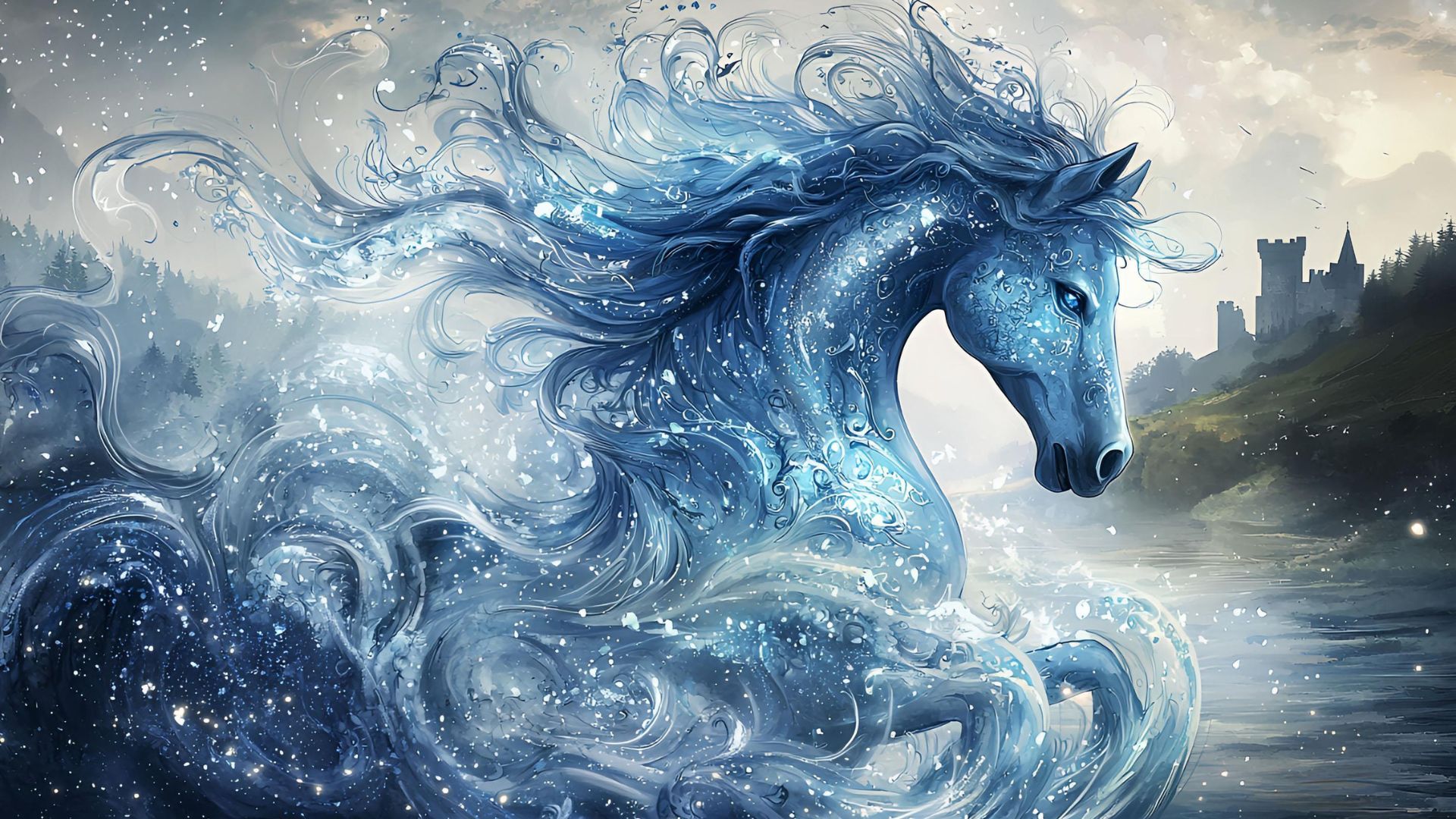
The kelpie belongs to water like this. A shape-shifting spirit that takes the form of a horse, it haunts the deep lochs and dangerous rivers of Scotland, and it is one of my favourite creatures in all of Scottish folklore. I rarely lead a story walk without featuring these majestic creatures.
Shape-Shifting Water-Horse
The kelpie is Scotland’s most notorious water spirit, one that haunts rivers and streams in the form of a beautiful horse. It stands at the water’s edge, gleaming and seemingly docile, as though it is simply waiting to be ridden.
However, the moment you reach out and touch its mane, you’ll find that you cannot let go. The kelpie’s hide is adhesive by nature, and once your hands are caught, the creature will drag you into the watery deep.
Not every kelpie stays in horse form. They are shape-shifters, and in human guise, they tend to be beautiful, a little too ethereal and perfectly placed near a loch at dusk. The giveaway, so the old stories say, is in the hair: water weeds caught where they should not be, or a dampness about them that has nothing to do with the weather. Those who survived generally did so because they noticed these smaller details and looked beyond the perfection.

Older Than the Stories
Before these creatures had their names, before the storytellers had shaped them into tales of a horse at a river’s edge, people were watching these same waters and understanding them to be inhabited.
The Picts, whose carved stones still stand across the north and east of Scotland, recognised spirits in springs, rivers, and lochs, places that could be dangerous and were respected. A river can easily flood without warning, lochs so cold and deep they can drown whoever enters them unprepared. The kelpie is likely an older water spirit passed down through centuries of oral tradition, reshaped by each generation who lived along the water’s edge. The stories worked on the subconscious in ways a simple warning might not.
From these rich stories developed, such as;
The MacGregor and the Bridle
There is a clan legend that features a kelpie. Near Loch Slochd, east of Loch Ness in the Highland heartland, a MacGregor ancestor once came face to face with a kelpie at the loch’s edge. Whether he sought the encounter or stumbled into it is not recorded. What we know is that he struck the creature with his claymore, grabbed its bridle, and ran. The bridle is the kelpie’s great vulnerability. Take it, and the creature’s strength and stamina are yours to command.
He made it home, passed the bridle through the window to his wife, and got it inside before the kelpie could recover it. The family has held it ever since, or so the legend insists, passed down through the MacGregor generations.
The Kelpie of Loch Garve
Some kelpie stories contain something that the warning tales do not: a glimpse into the creature’s thoughts and motives.
At Loch Garve in Ross-shire, a kelpie had taken a human woman as its wife and brought her to live in the loch. However, she found herself cold in the loch and that the raw fish were not to her liking. So the kelpie found the best stonemason in the Highlands and brought him, somewhat unwillingly, to the bottom of the loch and asked him to build a fireplace. The stonemason, despite working under coercion, built the most elaborately stunning chimney and mantelpiece ever seen. When the fire was lit, the kelpie’s wife was overjoyed and declared she could want for nothing more.
The stonemason was released, unharmed, with a promise of all the fish he and his family could eat for the rest of their lives. There is a spot on Loch Garve, even now, that does not freeze in winter. It is said to sit directly above the kelpie’s chimney.
The Water Horse of Barra
My favourite of all the kelpie stories takes place on the Isle of Barra, and unlike the others, it is one of transformation. This story is shared by the wonderful Winifred Finlay, and you can find it here.
We need to ask ourselves, what happens when we are observant, practise patience, and allow space for transformation?
This story also teaches us that there is something quietly extraordinary in a folklore tradition that can carry both, or many, truths at once: a wild spirit that can kill, and yet longs to be known, seen and loved.
Where to find Kelpies in Scotland
The River Spey is as good a starting point as any. Walk beside it in the evening, when the light is going, and the water is moving fast over the stones, and listen for something in the sound of it that goes beyond what you can see.
There is also the Kelpies Stane in the River Dee in Aberdeenshire, which they say was thrown by a Kelpie in a rage at a man who’d managed to escape his grasp. It stands there still
Loch Garve in Ross-shire is easy to overlook on a map. If you go, find the spot where the water stays open through winter and think about a kelpie who commissioned a fireplace and kept his word.
And if you find yourself on Barra, you can feel the enchantment, transformation and stories that the place as magical as this holds.
Of course, you can also visit the stunning Kelpie statues in Falkirk, which are a little easier to photograph and capture.
Why the Kelpie Keeps Coming Back
If any of this feels familiar to readers of romantasy, it should. The bridle that gives power over a supernatural creature, the dangerous shape-shifter reaching toward something human, the tension between predator and longing: these are the bones of a genre that knows exactly where it is drawing from. Holly Black’s Folk of the Air series uses the imagery of the bridle as a device of power and control in ways that will feel immediately legible to anyone who knows their kelpie lore.
That is the thing about kelpies. It has never been just another warning. Underneath the danger, there is something older and stranger: a creature that drowns the unwary and yet commissions a fireplace for a cold wife, that kills and yet longs to be seen. We keep returning to it because we recognise something in it of the world outside and within our own wild and untameable selves.
Tales of the kelpie endure because water itself endures, and because we have never quite stopped being bewitched by it.