How a fiddler’s last tune turned an outlaw into a legend
There is a clock that looks out over Dufftown that has its own story and tale to tell.
It sits in the tower at the centre of the square, where four streets meet. Most visitors pass beneath it without a glance, busily on their way to a distillery, a coffee, or a bite to eat. But the clock has a story, and the story too is worthy of a tale. You see, it was lifted from a tower in Banff, on the coast some thirty miles northeast, and the people of Banff would’ve been glad to be rid of it.
For this is the clock that hung Macpherson.
The Laird’s and Gypsy’s Son
James Macpherson came into the world around 1675, and almost everything about his beginning sounds like the opening of a ballad, which is fitting, because a closing ballad is what he became.
His father was a gentleman, a Macpherson of the Invereshie line, with land, a name and a place in the world. His mother was a young woman of the travelling people, beautiful by every account that survives, passing through the countryside as her people had always done. The two of them should never have met in any way that was lasting, and yet the laird acknowledged the outcome of the relationship as his own and raised young James at Invereshie House. Jamie grew up with all the comforts of a gentleman’s son, and once a year, when his mother’s people came back through the glen on their long seasonal round, she visited.
He was a child of two contradictory worlds, and yet he didn’t fully belong to either. That tension runs through the whole of his short life, like a boundary line that runs through two rivalling clans.
When his father died, said to have been killed during a cattle raid while James was still a young man, he could not inherit. So, he did the only thing left to him: rejoin his mother’s people and take to the road.
Robin Hood of the North-East
What he became next is the part that weaves in and through tales and folklore.
He started as a horse trader, which was honest enough work for a travelling man, before starting his own band, and they did what such bands at that time had always done. They took cattle and sheep from those who had plenty and let some of it find its way to those who had none. The everyday folk took to him the way the rural society has always taken to a generous thief. He came to be seen as a local Robin Hood, and the comparison has stuck with him for over three hundred years.
Yet despite his lifestyle, he is said to have had a gentleman’s code; there was to be no violence where it could be avoided, and no robbing or threats made to or in front of women, widows, or children. The band evolved their strategy, which was to watch the markets, see who had sold the most cattle and was riding home heavy with coin, and then to go and lighten that man’s load. It was thieving with a code, and the code mattered to him enough that breaking it would, in the end, as the tales recount, cost him everything.
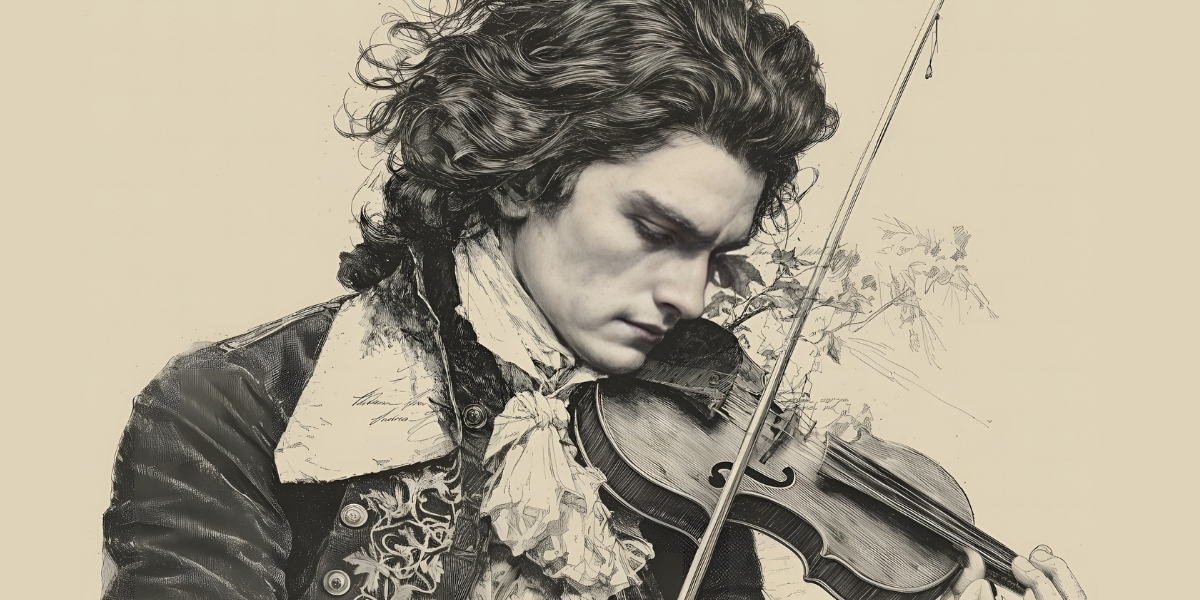
He was a swordsman of real reputation, fighting with a two-handed claymore, and a fiddler of rare gift. He was reputed to have played at many a ceilidh, to which the church took a dim view. However, I don’t believe he would have let the church’s opinion bother him much.
Every hero has his villain
For James Macpherson, that villain was Lord Alexander Duff of Braco.
Duff was determined to see take him down. More than once, he nearly had him, and more than once Macpherson slipped the net. He was captured at a time and held in Aberdeen, when a cousin and one of his band, with the help of the watching crowd, broke him out of the tolbooth. On another occasion, he was nearly run off the banks and right into the Deveron, and word went round that he had drowned in the river, only for him to be seen that same evening in Banff, alive and unbothered, having a drink.
Strong ethics can be both a weakness and a strength, so when one of his own band robbed a man in front of his wife and children, breaking with the band’s code, Macpherson cast him out. And we all know that a man with a grudge is a dangerous thing.
St Rufus market in Keith
Ironically, it all ended at a market, where he would have spent so much of his life wheeling and dealing.
James and his band came into town, led in by a piper (not modest at all), and Duff of Braco and his men were waiting for him. The fight that followed was a savage one. Braco himself came close to being killed in it. Macpherson very nearly cut his way clear, and might have, but for a woman at an upper window who threw down a heavy blanket as he passed beneath. By the time he’d freed himself of it, he stumbled, tripped over a gravestone, and was taken. A woman, a blanket and a headstone were to be the end of him.
He was held at Banff, where Duff had connections, and which played heavily into the trial.
Hanged for being an Egyptian
Banff could not properly try a man on a capital charge, and so the trial was rushed through before anyone could think too hard about it. The charge, he was found guilty of being an Egyptian. You see, the word used at the time was used for all gypsies, in the mistaken belief that the gypsies of Scotland had come out of Egypt. Ironically, neither he nor any other gypsy was Egyptian. The Romani of Scotland had come, by long roads and many generations, out of northern India, and the indigenous travelling folk, the tinkers and summer walkers, had never come from anywhere but Scotland itself. In parts of the country, these folk were welcome, returning each year on the same routes to help with the haymaking, the peat cutting and the building of stone walls. Yet, under the Act, being what he was, was enough to hang him.
The trial itself was rushed; sons-in-law of Branco sat on the Jury, and witnesses had fairly similar reports to share. They sentenced him quickly and condemned him to be hanged. And then, fearing that a pardon might be on its way, they hurried that along too.
The tune he left behind
In his last week, given a request, Macpherson asked for his fiddle, and he spent his last days composing what was to be his final rant.
On the morning of the 16th of November in the year 1700, they brought him to the gallows at the market cross, where he played his final rant before holding out the fiddle to the crowd and offering it to any man who would take it and play it over his body at his wake. As no one stepped forward, he took it and broke it over his knee.
Then he climbed the ladder and jumped, choosing to face death as he chose to face life ‘Sae rantinly, sae wantonly and sae daunting gaed he (as per his song: So boldly, so recklessly, so fearlessly went he).
The saddest part of the story comes last; it is said that a pardon was on the way from Aberdeen. A rider has been spotted carrying a reprieve, and the men in charge of the hanging knew it, or feared it, and so they put the clock forward, a quarter of an hour. The pardon, when it arrived, was too late.
Those responsible for moving the clock were reprimanded, and for years, the clock was left running ahead, a reminder of what had been done. A nice addition to the story is that when the neighbouring town of Macduff built its own clock tower, they gave it only three faces, leaving the side facing Banff blank. The folk of Banff, it was said, did not deserve to know what time it was.
James Macpherson died in 1700, but his story did not end there.
How the man lived on in legend and song
Macpherson’s story could have easily been forgotten; that final song is what has kept the legend alive.
It was sung at ceilidhs and carried by the travelling people, who have always kept a strong oral memory in their music and stories, many of whom would have stood in that Banff crowd on that fateful day. Since then, it passed from mouth to mouth and bow to bow for decades. Then, nearly a century after the hanging, Robert Burns came through the north-east and heard it, and did what Burns does. He took it up, reworked the words, and gave it back. That is the version most people know now as Macpherson’s Farewell, though the older, rougher Macpherson’s Rant and many other versions are still sung today.
Whether every detail of the tale is true, no one can say. Not everything was written down at the time, and a good story grows in the telling, gathering the things people feel ought to have happened until the legend becomes larger than life. His fiddle and a replica of his sword are housed at the Macpherson Museum. And on any given night, in a hall somewhere here in Scotland, someone will pick up a fiddle and play the tune he created, and everyone in the room will sing along.
With this, his story and his memory live on.
Perhaps that is why James Macpherson endures. Not because he was a saint, and not because he was a villain.
But because, somewhere along the way, he stepped out of history and into legend.
And the clock that is said to have stolen his final hours still watches over Dufftown.
Step Into the Story
If you enjoy the stories that lie beneath the surface of a place, these are exactly the kinds of tales I explore on the story walks of Dufftown and Inverness.
Speyside is filled with forgotten characters, local legends, folklore, and surprising pieces of history that rarely make it into guidebooks. Join a walk and step into the story.

Macpherson’s Rant
There are many versions of Macperson’s rant, here is one of them:
Fareweel, ye dungeons dark and strang, fareweel, fareweel tae ye,
MacPherson’s time will no be lang on yonder gallows tree
(Chorus) Sae rantinly and sae wantonly, sae dauntinly gaed he
For he played a tune and he danced aroon, below the gallows tree
It was by a woman’s treacherous hand that I was condemned tae dee
Above a ledge at a window she sat and a blanket she threw ower me
(Chorus)Sae rantinly and sae wantonly, sae dauntinly gaed he
For he played a tune and he danced aroon, below the gallows tree
There’s some come here tae see me hang, and some come tae buy my fiddle
But before that I would part wi her I’d brak her through the middle
And he took the fiddle intae baith o his hands and he brak it ower a stane
Sayin, nay other hand shall play on thee when I am dead and gane
(Chorus)Sae rantinly and sae wantonly, sae dauntinly gaed he
For he played a tune and he danced aroon, below the gallows tree
The reprieve was comin ower the Brig o Banff tae set MacPherson free,
But they pit the clock a quarter afore, and they hanged him frae the tree.
(Chorus)Sae rantinly and sae wantonly, sae dauntinly gaed he
For he played a tune and he danced aroon, below the gallows tree