Scotland has no shortage of castles. Drive an hour in almost any direction, and you will pass three, maybe four; there may even be a sign at the gate telling you the century it was built and the family whose name it is linked to. Yet, the sign rarely tells you why the tree in the cellar was never cut down, why the green lady weeps, or why a man who has been dead since the fourteenth century still has a familiar named Robin living in the ruins.
Those are the stories I go looking for when I am visiting a place. Some are old enough to have been carried by word of mouth before anyone wrote them down. Some are Victorian exaggerations or inventions dressed up as ancient truth. Most are somewhere in between, a historical event that got a little stranger each time it was told by the fire. I have tried to be honest here about which is which. A story does not need to be verified to be worth telling; after all, they say that ‘we shouldn’t let truth get in the way of a good story’, however, there are times that the truth is even stranger than the tales it was built upon, as you’ll find once you start digging.
Here are a few castles, with fascinating stories that make them well worth a visit.
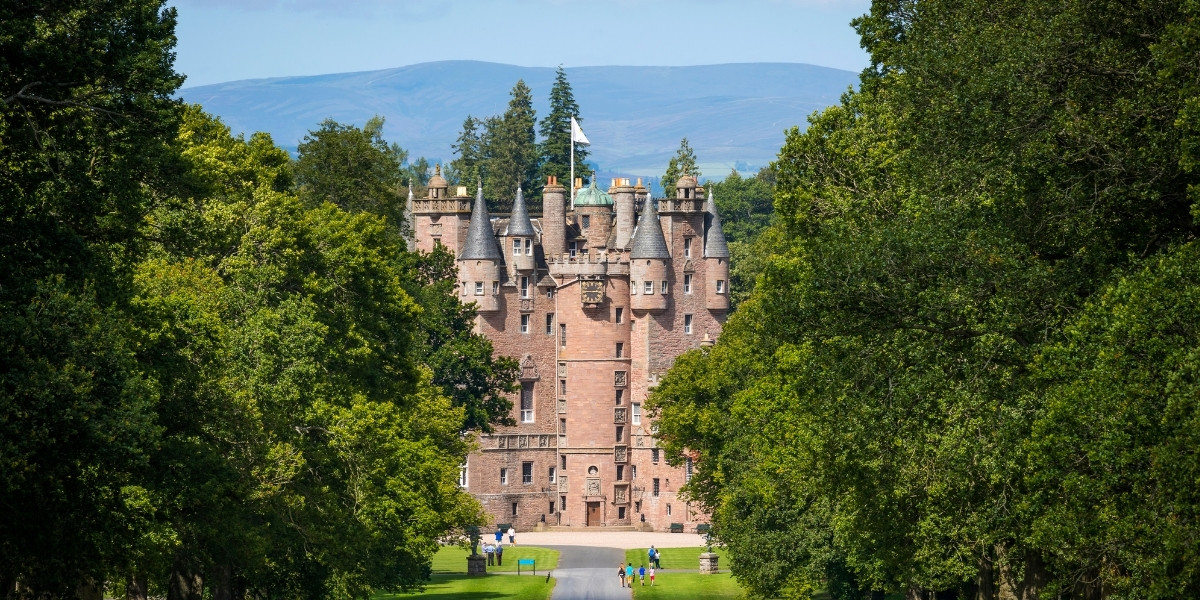
Glamis Castle: the heir who was never seen
Glamis, pronounced Glams if you want the locals to take you seriously, is the childhood home of the late Queen Mother and the Shakespearean seat of the Thane of Cawdor. But the story that has followed the castle longest has nothing to do with kings or queens.
In October 1821, a son was born to the 11th Earl of Strathmore. The official record states he died the same day, but no grave was ever found. For the rest of the century, rumours circulated that the boy had lived, badly deformed, and that his family had hidden him away in a secret chamber built into the castle’s ancient thickest walls, sixteen feet of stone in places. Only three people at a time were permitted to know the secret: the Earl, his heir once he turned twenty-one, and the estate factor. One workman is said to have glimpsed the hidden heir in a passage near the chapel and was quietly paid to emigrate to Australia rather than talk. Guests at a Victorian house party once tried to find the room by hanging towels from every window they could reach, then walking outside to count them. One window, they swore, had no towel and no matching room.
Glamis has a second, older tale worth knowing too. In 1486, the Devil himself is said to have arrived to claim the soul of Alexander Lyon, who, as a bit of a gambler, had ignored every warning against playing cards on the Sabbath and challenged the devil himself to a game. He is still known as Earl Beardie, and some say he still plays on somewhere within the walls, unable to stop until he wins a round, which he’s never done.
Fyvie Castle: the curse and the name in the stone
Thomas the Rhymer, the thirteenth-century poet who claimed the Queen of Elfland herself had granted him the gift of prophecy and the curse of never being able to lie, is tied to more Scottish legends than any other single figure. Many places claim a piece of him. Fyvie Castle has the best documented one.
Upon arriving at the castle gates one day, it is said that Thomas found himself shut out by a sudden violent gust of wind; it was as though the castle itself had turned against him. In answer, he laid on it the Curse of the Weeping Stones. Three stones, taken originally from a sacred burial site, would need to be reunited within the castle walls before any male heir could safely inherit it. One stone sits today in the Charter Room. Another is built into Preston Tower. The third, according to legend, lies somewhere in the River Ythan, waiting for someone patient enough to go and find it.
Fyvie has a second haunting, that of Lilias Drummond, married into the family in the sixteenth century; she is said to have been starved to death by her husband after she failed to give him a son. Not long after, he remarried, and on his wedding night, ghastly screams were heard outside the newlyweds’ chamber, and by morning Lilias’s name had appeared carved into the stone sill of a window on the outside wall, a wall no one could have reached without a ladder or a rope. It is still said to be visible there today.

Dunvegan Castle: the flag that saved a clan three times
On Skye, hanging in Dunvegan Castle is a well-protected, faded piece of silk that Clan MacLeod has treated as its most precious possession for eight centuries. The Fairy Flag’s origin story is one of enchantment, they say a MacLeod chief fell in love with and married a fairy woman for a year and a day, as their custom required, and that when their infant son cried inconsolably one night, she returned briefly from her own world to wrap him in her shawl and sing him a lullaby that clan nurses still sing to MacLeod children today. However, before she left for good, she told her husband the flag could be waved three times in the clan’s darkest need, and each time, help would come, and on the fourth, it would vanish.
It has been unfurled twice in memory, once during a massacre by rival MacDonalds, when the small band of defenders on the beach appeared to multiply tenfold the moment the flag rose, and once during a cattle plague that threatened the clan with starvation. During the Second World War, MacLeod airmen carried photographs of the flag into battle as a charm, and it is said that not one of them who carried it was lost. The flag itself remains at Dunvegan today, and its story is one of my very favourites.
Ballindalloch Castle: built where the good folk allowed it
Speyside’s Ballindalloch has been called the Pearl of the North, and it earns the name, sitting low in a green valley where the River Avon meets the Spey, and there is a reason it’s there.
When John Grant first set out to build his castle in the sixteenth century, he chose a hillside above the river, which was a much stronger and more defensible spot. Every morning his masons found the previous day’s work undone, the stones scattered as though thrown by some hidden unseen force. Grant kept vigil one night to catch whoever, or whatever, was responsible, and was himself swept off the hill by a fierce wind said to carry a voice within it, instructing him to build instead in the coo haugh, the cow meadow by the water. He obeyed, and the castle that stands today has never had any trouble since.
Ballindalloch’s Green Lady is said to be a young Grant daughter who died for love that was never allowed to flourish, and locals describe her as a gentle rather than restless ghost.

Cawdor Castle: the donkey, the gold, and the tree in the cellar
Every visitor to Cawdor learns quickly that the castle has nothing genuine to do with Shakespeare’s Thane, who died some four centuries before these walls were raised. What they do have is a foundation story stranger than any playwright’s tale.
The Thane of Cawdor, instructed by a dream, is said to have loaded a chest of gold onto the back of a donkey and let the animal wander the district freely for a day, with the promise that wherever it chose to rest, there his new tower would stand and prosper for as long as the family held it. The donkey lay down beneath a lone thorn tree on a rocky rise above the burn, and the tower was built around it. That tree still stands today in the vaulted cellar, ancient and hollowed, believed to have been a hawthorn, though modern analysis of the wood says it is in fact holly. Whether hawthorn or holly it was worth building an entire home around to keep it standing.
Cawdor’s also has another tale, that of Muriel Calder, the infant heiress left as sole heir to the Thanedom in 1498. Her uncles feared she would be kidnapped to secure her fortune through marriage, and the fear proved right. Before the Campbells of Argyll could seize her, her nurse branded the baby’s hip with a red-hot key and bit the tip from her little finger, so that whatever became of her, her family would always know her again by the mark. Muriel was taken all the same, raised at Inveraray, and later married to the Campbell heir, but the mark did its work, and Cawdor has belonged to that same Campbell line ever since.
Slains Castle: the ruin that inspired Dracula
Cruden Bay’s clifftop ruin looks, even now, roofless and hollow-eyed above the North Sea, like something a novelist would invent rather than something that simply happened to exist. Bram Stoker seemed equally enchanted by it. He holidayed in the village for seventeen summers and is widely believed to have drawn on Slains for the look and feel of Castle Dracula, in the early drafts of his novel.
Anyone who knows their Highland folklore may take his inspiration a step further, wondering whether Stoker’s three vampire brides owe something to the Baobhan Sith, the beautiful and lethal women of Gaelic legend said to lure travellers in with a dance before draining them of blood. It is a tempting thread to pull, and Stoker’s own Irish mother did fill his childhood with dark tales of her own. But it remains speculation rather than something Stoker ever confirmed, so we can only guess at how much the Baobhan Sith did and didn’t inspire him.

Hermitage Castle: the goblin who kept a wicked man safe
Down near the Border, in country that changed hands so often between Scotland and England that the walls were built with almost no openings at all, stands Hermitage. Its most infamous resident, Lord William de Soulis, is remembered in legend as a practitioner of black magic who kidnapped local children for his rituals and kept, as his familiar, a goblin called Robin Redcap, who dyed the cloth of his cap in the blood of Soulis’s victims to keep himself alive.
Redcap is said to have granted his master a terrible gift: no lance, arrow, sword, or knife could harm him, and no rope could bind him. It made him seem untouchable, until the local people, having endured enough, dragged him to Ninestane Rig, a stone circle just outside the castle walls, wrapped him in lead, and boiled him alive in a great cauldron over an open fire.
Historically, real life tells as it often does a much duller story: that the real de Soulis died a prisoner at Dumbarton Castle after a failed plot against Robert the Bruce. Folklore and campfire tales obviously tend to prefer the version with the cauldron.
Rait Castle: the feast that turned to slaughter
Rait, a quiet ruin south of Nairn, holds one of the north’s darkest tales. In 1442, the Comyn family, locked in a long feud with the Mackintoshes over the lands, invited their rivals to a feast under the pretence of reconciliation. Hidden weapons waited nearby, and a black bull’s head, brought to the table, was to be the signal to strike.
But it is said that the Comyn laird’s own daughter had fallen in love with a young man of Clan Mackintosh, and warned him of the plan. Forewarned, the Mackintoshes turned the ambush against their hosts. As the laird searched the castle afterwards in fury, he found his daughter trying to escape through an upper window and, in his rage at her betrayal, cut off her hands, and she fell out of the window to her death. Her ghost is still said to walk the ruins, seeking the hands that were taken from her.
Comlongon Castle: the lady who would not be sold in marriage
Down in Dumfriesshire, Comlongon holds one of Scotland’s quieter tragedies, closer to a true crime story than a fairy tale. In 1563, Marion Carruthers inherited half her father’s estate alongside her sister, and immediately became a prize to be fought over. A powerful neighbouring family, the Douglases, wanted her land and arranged a marriage she never consented to. She fled to Comlongon, her uncle’s castle, and even surrendered half her dowry in the hope it might buy her freedom from the match. It did not. After much fighting, even the Queen and the courts ruled against her in favour of the Douglas family.
On the 25th of September 1570, records state that Marion took her own life by leaping from the castle’s lookout tower. Many who have told her story since believe it was murder dressed up as suicide by men who history would have it, gained greatly from her death. Grass, it is said, has never grown again on the spot where she fell, and her ghost, known now as Comlongon’s Green Lady, is still said to be heard weeping through the tower she once hoped would shelter her.
Duntrune Castle: the piper’s warning
On the shores of Loch Crinan, Duntrune’s story belongs to a single act of loyalty. In 1644, during fighting between Clan Campbell and Clan MacDonald, a MacDonald piper had been left within the castle when his chief, Alasdair Mac Colla, sailed off with the bulk of his men. When the Campbells retook Duntrune and MacColla’s galley was seen returning, unaware his enemies now held the castle, the piper climbed to a high window and played a warning tune, one his own chief would recognise, urging him to turn away.
MacColla understood, and sailed on to safety. The Campbells, furious at what the piper had done, cut off both his hands so he would never play again, and he bled to death from the wounds. Visitors and residents alike have long reported the sound of bagpipes drifting across the loch on quiet nights, a tune and a reminder of one piper’s last act of loyalty to his chief.
Crathes Castle: the woman found beneath the hearth
Crathes, on Royal Deeside, has a Green Lady mystery. For generations, staff and visitors, including Queen Victoria herself, reported seeing a woman in a green gown cross one particular chamber carrying a baby in her arms before vanishing into the wall beside the fireplace. The story told alongside the sighting was that a young woman, said to have been a servant or a ward of the house, had fallen pregnant to someone below her station and disappeared along with her child not long after giving birth.
During renovations in the 1800s, workmen lifted the hearthstone in that exact room and found, beneath it, the skeletal remains of a young woman and an infant. No names were ever attached to the bones, and no record explains how they came to be there. The room has been known as the Green Lady’s Room ever since, and the sightings continue to this day.
Balvenie Castle: old and new: two castles, two hauntings
Most visitors to Dufftown walk straight past the ruin behind Glenfiddich on their way to the distillery, and that is a shame, because Balvenie Castle is magical and has a story of its own. Built in the thirteenth century by the Comyn Earls of Buchan and later held by the Stewart Earls of Atholl, it stood as a working residence for close to five hundred years, hosting Edward I and later Mary, Queen of Scots herself. Its end came quietly rather than in battle. In 1718, its owner William Duff took his own life within the walls, and the castle was never lived in again. Within a few years the roof was gone, and the slow work of ruin began. Some who have stood at the window of the old laird’s chamber report the same lingering unease.
Barely a mile away stands a second ‘New Balvenie Castle’, that was more a house than a castle. When the old castle finally fell to ruin, the Earl of Fife, its owner, had its stones carried off and used to build the new house nearby, which he dubbed ‘New Balvenie Castle’, which is now long gone too. But its foundations lie beneath what is now The Balvenie distillery, yet the ghost remains. Distillery maltmen, working alone through the night as the barley turns, have described hearing her quiet footsteps on the malting floor for generations. She is known simply as the Green Lady. The question remains: was she really the mistress of the Earl, or someone else and their story is simply lost to time?

So Many castles have a story worth telling
Stories are what I go looking for on my travels, and that I share on my story walks through Dufftown and Inverness. Whether you are visiting or living here in Scotland, I hope that you find a few equally enchanting stories worth sharing.
Note:
A few of these castles, such as Balvenie and Hermitage, are cared for by Historic Environment Scotland rather than a private family or trust, which means a Historic Scotland membership gets you through the gate for free, along with many other properties across Scotland. If history and stories are of interest and you’d like a membership, you can apply here.
Images courtesy of Visit Scotland