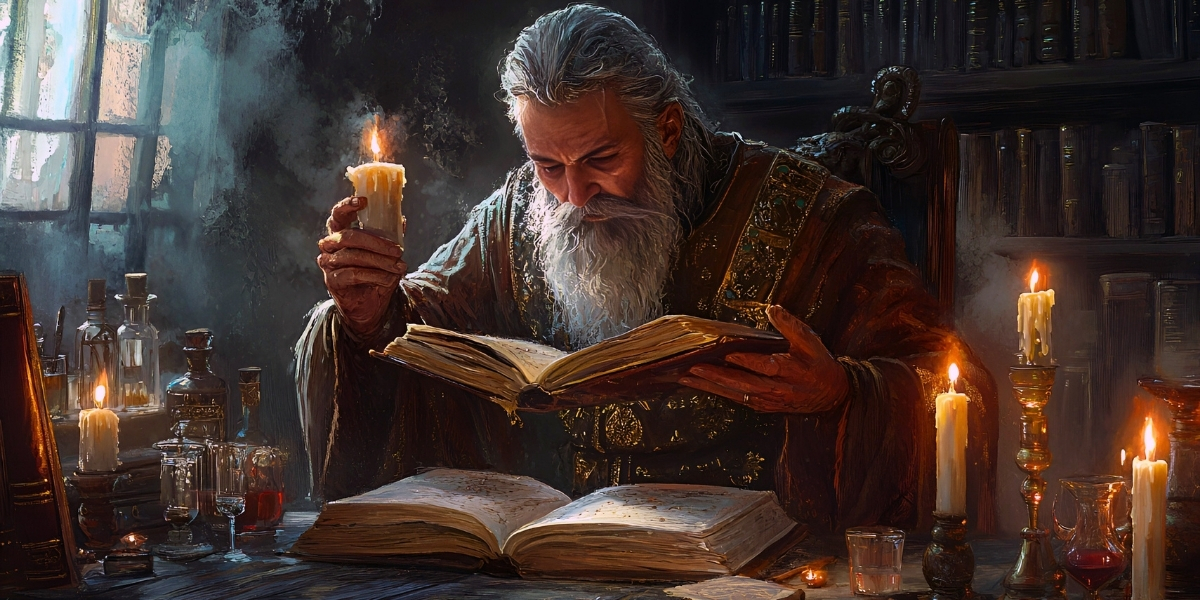
The Life and Legend of Michael Scot
In the Scottish Borders, where the Eildon Hills rise in three distinctive peaks above the town of Melrose, there are stories the landscape keeps. Stories older than the stones of the abbey, carried on the wind across the River Tweed, whispered in the names of old crossroads and causeways. Many of them belong to one man: Michael Scot, the Wizard of the North. And unlike most wizards, he really existed.
The Scholar Who Seemed Like a Sorcerer
Born around 1175, most likely in the Scottish Borders or Fife, Michael Scot grew up to become one of the most extraordinary minds of the medieval world. He studied at Durham, Oxford, and Paris, then travelled further afield to Bologna and Toledo, where he learned Arabic and found himself at the great crossroads of global scholarship. Toledo in the early thirteenth century was a city where Christian, Islamic, and Jewish learning overlapped and challenged one another, and it was there that Scot translated the works of Aristotle and Averroes from Arabic into Latin, opening them to European thinkers for the first time. That single contribution alone would have secured his reputation for centuries.
But Scot was not a man content to stay in one lane. His curiosity ranged across alchemy, astronomy, mathematics, astrology, and the natural sciences. He wrote about the heavens, the nature of the soul, and the workings of the human body. He wore vivid, distinctive robes. He moved easily between courts and cultures that most people of his time would never see. To those who encountered him, he seemed like something more than a scholar, something closer, perhaps, to a magician.
Frederick II, Holy Roman Emperor and King of Sicily, known to his contemporaries as Stupor Mundi, the Wonder of the World, recognised a kindred spirit when he found one. Around 1220, he brought Scot to his court, where Scot served as court astrologer and science adviser. The two men developed a genuine friendship, rooted in a shared curiosity about how the world worked and a shared delight in testing its edges.
One story captures their dynamic perfectly. Frederick invited Scot to climb a church tower and recalculate the distance to the heavens. Scot climbed, measured, and returned with figures that did not match his previous calculations. He replied, perfectly calmly, that either the heavens had moved further away since his last measurement, or the tower had somehow shrunk. Frederick had, in fact, quietly arranged for the tower to be lowered before the climb. Scot was not someone who was easily fooled.
A Few Degrees of Separation
I came to Michael Scot sideways, the way the best discoveries often do, through research that was looking for something else entirely. And then, as I followed the thread of his life, something felt oddly familiar.
Many years ago, I rented a flat in Ortigia, the ancient island at the heart of Syracuse in Sicily, in a building that was once owned and used by Frederick II as a summer escape. I remember the view over the coast. I remember the frescoes. I remember the bathtub, carved from a single vast piece of marble, so old I never once brought myself to use it. And I remember watching the starlings create their endless, enchanting patterns across the sky as the sun went down.
Now, deep in research, I was reading that Frederick’s court astrologer and close companion had spent years in that very Sicilian court. If Frederick was there, Scot was not far behind. Perhaps he walked through those same rooms. Perhaps he watched the same starlings turn and swoop above the coast, and stood at the same window looking out over the same stretch of sea.
The degrees of separation collapsed to almost nothing. It is one of the great quiet pleasures of this kind of research, the moment when the story reaches out and touches your own life in a way you could never have anticipated.

The White Snake: How He Got His Powers
Before Michael Scot became the legend of the Borders, the story goes, he was simply a young man walking the old tracks through the hills and forests. One day, travelling with companions, they heard a loud hiss behind them. A great white serpent was rearing up on the hillside, coiling towards them, ready to strike. His companions fled. Scot stood his ground, raised his wooden staff, and struck the creature, killing it.
That evening, the woman who took them in asked about the serpent, took its body, and dropped it into a pot she had prepared over the fire. “It’s the only way to destroy it,” she told him, leaving Scot to tend to it while she was occupied elsewhere. His curiosity got the better of him. He dipped his finger into the simmering liquid and brought it to his lips.
In that instant, everything changed. Knowledge of all that had ever been and all that was yet to come flooded through him. Power he had never imagined was suddenly his.
It is a pattern that surfaces again and again in the myths of these islands. In Wales, Gwion Bach accidentally tastes three drops from the goddess Ceridwen’s cauldron and becomes the great poet Taliesin. In Ireland, young Fionn mac Cumhaill touches the Salmon of Knowledge and receives all wisdom. The vessel changes; the moment of accidental discovery remains. Some knowledge, it seems, cannot be sought. It can only be stumbled upon, tasted almost by accident, from something that was never quite meant for you.
The Marks He Left on Scotland
In the Borders, Michael Scot did not merely live in the landscape; he shaped it, or so the stories say. The three peaks of the Eildon Hills, rising so distinctively above Melrose and visible for miles across the countryside, are said to be his doing. The hills were once a single peak. Scot, or in some tales, a demon working at his command, split them into three in a single night.
That demon proved difficult to contain once the work was done. Too powerful to release and too dangerous to leave idle, Scot set it an impossible task: to weave ropes from sea salt. It is still working at this, so the story goes.
His name runs through the landscape in other ways, too. He is said to have altered the very course of the River Tweed. Local tradition ties him to a causeway, one of those feats of near-impossible building that people, quite reasonably, attributed to magic where no other explanation makes sense. Landmarks, crossroads, and old stones across the Borders still carry his name: a geography shaped by the memory of a man the land could not quite let go.

Finding Michael Scot in Scotland
If you want to walk in his world, the Eildon Hills above Melrose are the place to begin. Standing on those three peaks, looking out over the town and the abbey and the long curve of the Tweed below, you understand why the Borders kept his stories alive for eight centuries. It is a landscape that holds myth naturally, old, layered, and quietly aware of itself.
Melrose Abbey is where he is said to rest. His books of magic, the story goes, were sealed in his tomb beside him, their knowledge too dangerous to leave unguarded. Walter Scott, a very different Scot, but one who admired him deeply, wrote that those books still glow faintly in the dark of the crypt. Whether you believe that or not, the abbey at dusk, the old stone warm from the afternoon sun, carries something otherworldly.
These are not just places on a map. They are landscapes where his stories still linger, in the shape of the hills, in the rush of the river, in the names that have stuck to the land for centuries.
The Death He Could Not Outrun
Michael Scot foresaw his own death. He knew, he said, that a small stone would fall upon his head and kill him, and he had even calculated its weight. And so for years he wore an iron skullcap, day and night, convinced that if he never gave fate its opening, fate could not find him.
And then one day, attending mass at Melrose Abbey, out of respect for the sacred space, he removed his cap. A small pebble fell from somewhere above and struck him on the head. He fell ill not long after and died. The stone had weighed, some say, exactly as much as he had predicted.
There is something in this that echoes the death of Merlin, the great wizard undone not by force, but by his own knowledge, caught in the end by the very gifts that had defined him. Michael Scot saw everything coming. Yet, he was unable to change his fate.
The Legend That Wouldn’t Stay Still
He is the only Scot to appear in Dante’s Inferno, placed in the Eighth Circle of Hell among the sorcerers and false prophets. It is, in its way, a strange kind of honour, since Dante reserved that circle for those whose power was considered genuinely significant. Walter Scott then honoured him in The Lay of the Last Minstrel, centuries later, cementing his place in the Scottish literary imagination. The two Scotts, separated by six centuries, had found each other across time.
What keeps Michael Scot alive, across all of it, is the way the real and the legendary in him are so perfectly balanced. He was a genuine scholar, scientist and alchemist, one of the most important translators of the medieval world. He was also, by most accounts, a singular and vivid human being, curious, wide-ranging, and entirely at home in places and ideas that made other people uncomfortable.
The folk imagination of Scotland took that truth and followed it to its natural conclusion. He became the man who split the hills and bridled the river. The wizard whose books still glow in the crypt. The prophet who met his fate exactly as he had foreseen, iron cap and all.
Some people are simply too large for their own time. Their lives spill out into story because the facts alone cannot quite hold them. Michael Scot was one of those people.
And if you walk the Eildon Hills on the right kind of evening, the light going golden, the Tweed glinting far below, you can still feel him there.